

Key West Fishing Regulations and Licenses
Why Key West Fishing Rules Are Different
Key West has some of the most productive and most protected waters in the country. Florida and federal managers set seasons, size limits and bag limits to keep species like grouper, permit, snapper and tarpon healthy for the long run. The good news: on a licensed Key West fishing charter, your captain handles almost all of it.
This guide explains the rules in plain English so you know what to expect before you step on the boat. For what's biting each month, see our Key West fishing calendar.
State waters vs. federal waters
The line between state and federal waters changes the rules.
- Atlantic side: state waters run from shore out to 3 nautical miles. Beyond that is federal water, where most offshore fishing happens.
- Gulf side: state waters run out to 9 nautical miles.
Key West has a twist. Florida applies its Atlantic rules for many species, including grouper and hogfish, to all state waters off Monroe County, on both the Atlantic and Gulf sides. So a grouper caught in the backcountry north of Key West follows Atlantic grouper rules.
Who sets the rules
- FWC (Florida Fish and Wildlife Conservation Commission) manages state waters.
- NOAA Fisheries, with the South Atlantic and Gulf councils, manages federal waters.
- NOAA's Highly Migratory Species program manages sailfish, marlin, swordfish, tuna and sharks.
- The Florida Keys National Marine Sanctuary adds protected zones around the reef.
Do You Need a Fishing License in Key West?
On a licensed Key West fishing charter, no. Florida exempts anyone saltwater fishing from a for hire vessel (guide, charter or party boat) that holds a valid charter license. The boat's license covers every angler aboard, residents and visitors alike.
When the charter license covers you
- Fishing for saltwater species from a licensed charter boat
- Reef fish trips: you do not need the State Reef Fish Angler designation either, because the captain handles reporting
- Sailfish, swordfish and tuna: the boat's federal HMS Charter/Headboat permit covers everyone fishing aboard
When you need your own license
- Fishing from your own boat, a rental boat, a kayak or a paddleboard
- Fishing from shore or a bridge (Florida residents can get a free shoreline license)
- Freshwater fishing, which is never covered by a saltwater charter license
Visitors 16 and older can buy a Florida nonresident saltwater license online at GoOutdoorsFlorida.com in a few minutes. Kids under 16 do not need one.
Special permits a charter may not cover
- Spiny lobster: the charter license covers lobstering only if the boat also holds a spiny lobster permit. Ask before you book a lobster trip.
- Snook: same rule, though snook are mostly a backcountry and mainland target.
- Tarpon tag: the only way to keep a tarpon, and only for an IGFA world record attempt. Charter exemptions do not apply to tarpon tags.
Bottom Line: Book a licensed charter or get your own if you are using your own boat or renting a boat.
Catch and Release Species in Key West
Some of Key West's most famous fish are worth far more alive than in a cooler. These species are released every time, or most of the time.
Tarpon: always released
Tarpon have been catch and release only in Florida, in both state and federal waters, since 2013. The only exception is a single fish kept with a $50 tarpon tag while chasing an IGFA world record.
- Tarpon over 40 inches must stay in the water. Smaller fish can be lifted briefly for a photo.
- Hook and line only, and no multiple hook rigs with natural bait.
- Your captain will revive the fish alongside the boat before letting it go.
Bonefish: always released
Bonefish are catch and release only, with no tournament or trophy exception. A quick photo is fine; then it goes back.
Permit: seasonal release only
All of the Florida Keys sit inside FWC's Special Permit Zone. From April 1 through July 31, permit harvest is closed during the spawn, but catch and release is allowed. The rest of the year, the limit is 1 permit per person and 2 per boat, with a 22 inch fork length minimum. Most Keys guides release nearly every permit year round.
Goliath grouper: release in Key West
Goliath grouper have been protected since 1990. Florida now runs a tiny lottery harvest of up to 200 juvenile goliath a year, but harvest is not allowed in state waters from Martin County south through the Atlantic coast of the Keys, in Dry Tortugas National Park, or in federal waters. Adult goliath are off limits everywhere. On a Key West charter, every goliath goes back.
Sailfish: practically always released
Sailfish must be at least 63 inches from lower jaw to fork to keep, and Key West charters release virtually all of them. If you plan to release a sailfish in federal waters, it cannot be pulled out of the water. Your mate will get you a great photo boatside.
Key West Seasonal Closures by Month
Most closures protect fish while they spawn. During a closure, you can usually still catch and release the species; you just cannot keep it.
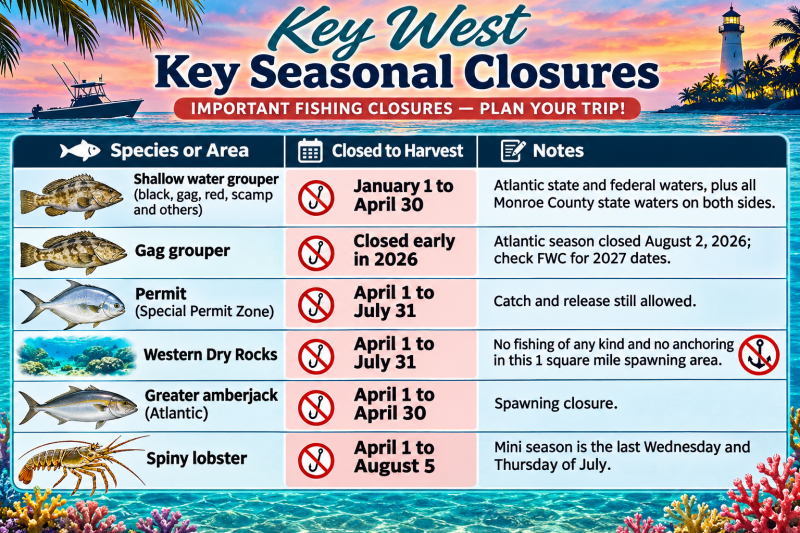
New for 2027: Gulf grouper changes
A federal rule published in June 2026 changes Gulf grouper fishing starting January 1, 2027. In federal Gulf waters, the "other shallow water grouper" group, which includes black, scamp, yellowfin and yellowmouth grouper, will be closed from January 1 through June 30 each year and open July 1 through December 31. If you are planning a winter or spring grouper trip on the Gulf side, expect to release them.
What stays open year round
Yellowtail, mutton and mangrove snapper, mahi, wahoo, blackfin tuna, king mackerel and cobia have no closed season in Monroe County, only size and bag limits. That is why Key West reef and offshore fishing produces dinner in every month of the year.
Size and Bag Limits for Popular Key West Fish
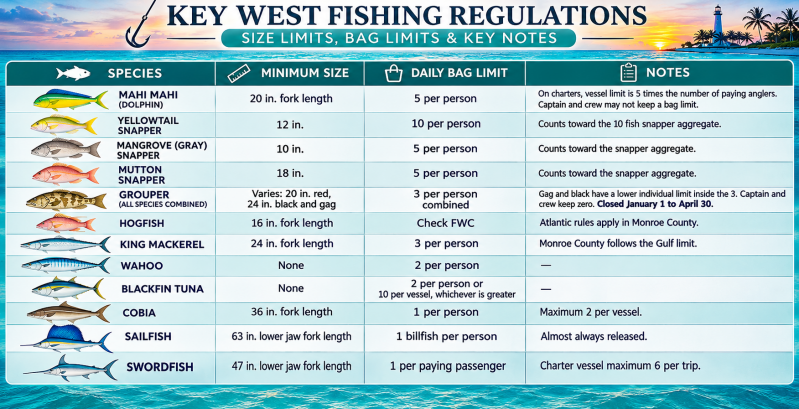
These are the limits for the fish Key West anglers keep most often, in Monroe County and Atlantic state waters. Limits are per person per day unless noted. Federal limits can differ slightly offshore, and your captain will follow whichever applies.
Why measurement matters
Florida measures most fish by fork length (tip of the snout to the fork of the tail) or total length, and billfish and swordfish by lower jaw fork length. An undersized fish has to be released right away. Your mate measures every keeper on the boat, so you never have to guess.
Keeping fish whole
Most reef fish must stay whole (gutting is fine) until you reach the dock, so officers can check size and species. Your crew will fillet your catch back at the marina.
Protected Areas Around Key West
Some of Key West's best known spots have special rules. Your captain knows exactly where the lines are and plans the day around them.
Western Dry Rocks
About 10 miles southwest of Key West, Western Dry Rocks is a 1 square mile reef where permit, mutton snapper, yellowtail, mangrove snapper and grouper gather to spawn. From April 1 through July 31, all fishing and possession of fish is prohibited there, anchoring is prohibited, and boats may only pass straight through. Research by Bonefish and Tarpon Trust found the site attracts roughly 70 percent of tagged permit from the Lower Keys flats, which is why protecting it matters for flats fishing everywhere in the Keys.
Florida Keys National Marine Sanctuary zones
The whole reef tract sits inside a national marine sanctuary. Most of it is open to fishing, but certain small zones on popular reefs are no take areas set aside for snorkeling and diving, and some reef areas limit anchoring to protect coral. Look for yellow boundary buoys, use mooring balls where available, and let your captain choose the spots. Sanctuary zone maps
Dry Tortugas
Much of Dry Tortugas National Park and the nearby Tortugas Ecological Reserve are closed to all fishing, and goliath grouper harvest is banned throughout the park. Fishing trips that run toward the Tortugas target open waters outside those boundaries. [ADD: link to Dry Tortugas charter page]
Bridges, channels and residential shorelines
During lobster seasons, snorkeling and diving for lobster is not allowed within 300 feet of residential or commercial shoreline in the Keys. Many bridges also have posted fishing restrictions, so check signs before you cast from shore.
Lobster and Stone Crab Rules in Key West
Spiny lobster
Season
Dates
Key rules
Mini season (sport season)
Last Wednesday and Thursday of July (July 29 and 30 in 2026)
6 per person per day in Monroe County. No night diving in Monroe County. Starts 12:01 a.m. day one, ends midnight day two.
Regular season
August 6 to March 31
Night diving allowed. Closed April 1 to August 5.
What you need for lobster:
- A Florida saltwater fishing license and a spiny lobster permit, unless you are on a charter whose license includes a lobster permit
- A measuring device, because lobster must be measured in the water
- To release any female carrying eggs
- To stay 300 feet or more off residential and commercial shorelines while snorkeling or diving for lobster in the Keys
Mini season is the busiest boating week of the year in the Keys, and FWC and the Coast Guard check almost every boat. Booking a private charter takes the stress out of it.
Stone crab
Stone crab claw season opens October 15 and closes May 1. Only claws are harvested; the crab always goes back in the water alive. Recreational trap rules apply, so most visitors enjoy stone crab at a restaurant rather than on a fishing charter.
What Your Captain Handles (and What You Can Do)
One of the biggest perks of a private Key West fishing charter is that you never have to read a regulation book on vacation.
Your captain takes care of
- The charter license that covers every angler aboard
- Federal HMS permits for sailfish, swordfish and tuna
- Knowing where the state and federal lines, sanctuary zones and closed areas are
- Measuring every fish and keeping you inside the size and bag limits
- Required reporting and safe release gear on board
How you can help every fish you release survive
- Keep big fish wet. Tarpon over 40 inches stay in the water, and released sailfish should too.
- Be quick. Have the camera ready before the fish comes boatside.
- Support the belly. Hold fish horizontally with wet hands, never by the gills or jaw alone.
- Let the crew vent or descend deep fish. Grouper and snapper from deep water often need a descending device to get back down safely.
- Watch for sharks. If a shark is following, your captain may cut the line early to give a released fish its best chance.
Respecting these rules is what keeps Key West fishing this good, year after year.
Key West Fishing Regulations FAQ
Do I need a fishing license on a charter in Key West?
No. Florida exempts anyone saltwater fishing from a for hire vessel that holds a valid charter license, so the boat's license covers every angler aboard, residents and visitors alike. You only need your own license when fishing on your own, from a rental boat, or from shore. Lobstering requires the boat to also carry a lobster permit.
When is grouper season in Key West?
Shallow water grouper, including black, gag and red grouper, are closed to harvest from January 1 through April 30 in Atlantic waters and all Monroe County state waters. They reopen May 1. Gag grouper closed early on August 2 in 2026, so check FWC for current dates. You can catch and release grouper during closures.
Can you keep tarpon in Florida?
No. Tarpon are catch and release only in Florida state and federal waters. The only exception is one fish kept with a $50 tarpon tag in pursuit of an IGFA world record. Tarpon over 40 inches must stay in the water during release, and only hook and line gear may be used to target them.
Can you keep permit in Key West?
Sometimes. The Florida Keys are inside the Special Permit Zone, where permit harvest is closed April 1 through July 31. The rest of the year, the limit is 1 per person and 2 per boat, with a 22 inch fork length minimum. Many Key West guides release every permit to protect the fishery.
How many mahi can you keep in Key West?
In Atlantic state waters off Key West, the limit is 5 mahi per person per day, and each fish must be at least 20 inches fork length. On a charter, the boat can keep 5 for each paying angler, but the captain and crew cannot keep their own limit.
When is lobster season in Key West?
The regular spiny lobster season runs August 6 through March 31. A two day mini season takes place the last Wednesday and Thursday of July, with a limit of 6 lobster per person per day in Monroe County and no night diving. You need a saltwater license and a spiny lobster permit unless your charter's license covers lobster.
What is Western Dry Rocks?
Western Dry Rocks is a 1 square mile spawning reef about 10 miles southwest of Key West. From April 1 through July 31, all fishing and anchoring are prohibited there to protect spawning permit, snapper and grouper. Boats may pass through without stopping. It reopens to fishing on August 1.
Keep Reading
- What's Biting in Key West: A Month by Month Fishing Calendar
- Key West Tarpon Fishing Guide
- Half Day vs Full Day Fishing Charters in Key West
Fish Key West the Easy Way
Licenses, permits, size limits, closed areas: on a private Key West fishing charter, our captains handle all of it so you can focus on the fish. Tell us your dates and what you want to catch, and we will put you on what's biting and legal to keep.
Contact the Captains first!
Call or text (305) 209-3414
Book online at kwcaptains.com
Regulations change often. This guide reflects Florida and federal rules as of November 2026. Always confirm current rules at MyFWC.com or with your captain.
The Key West Captains Team